

Custom FedEx shipping contracts typically include an earned discount program. This gives your business access to additional percentage discounts that kick in based on how much you spend.
Most shippers know this exists. But they assume it’s straightforward: hit the threshold, get the discount.
That’s not always the case. Many earned discount programs are recalculated every week based on a rolling 52-week window. Some exclude zones entirely, only apply to specific account structures, and the fine print on the calculation determines whether the discount on your contract is actually what you’re receiving.
I’ll explain how FedEx discount programs really work, and where the mechanics get tricky. This will help you better understand whether you’ve negotiated a good discount that makes sense based on your shipping volume.
What an Earned Discount Program Looks Like
A FedEx earned discount program is a tiered percentage discount that stacks on top of your base discounts.
Here’s a typical structure from a real FedEx proposal we obtained:
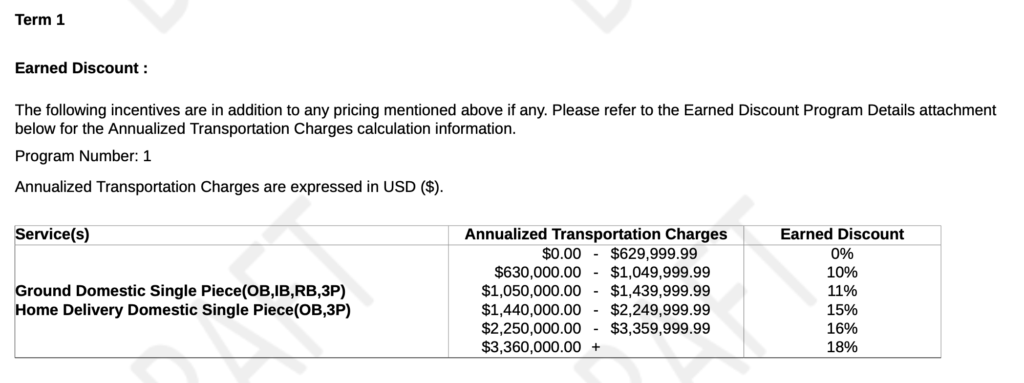
In this example, the shipper doesn’t earn anything until they cross $630k in annualized transportation charges. Once they cross that threshold, they earn 10% off base rates on eligible shipments.
As spend grows into higher tiers, the discount percentage grows with it. The discount is in addition to whatever base discounts are already applied in the contract. But the discounts compound instead of simply adding together.
Here’s how that actually works:
- Say the published rate on the package is $100.
- Your contract has a 43% base discount. That saves you $43, so you owe $57.
- Now your 11% earned discount kicks in, which comes off the $57 you owe (not the original $100).
- Your earned discount on this shipment is $6.27 (11% of $57).
- Final price: $50.73 or a ~49% effective discount on the published rate.
That’s how the compounding works here.
Each additional discount is applied to a smaller number, so the effective rate is always going to be less than a straight addition would suggest. Many businesses assume that their discount in this scenario would have been 54% (43% + 11%). But that’s incorrect.
Your Total FedEx Spend Isn’t What Determines Your Tier
Before diving into the calculation mechanics, there’s another important detail that trips up almost every shipper looking at an earned discount table for the first time.
The threshold is not based on your total FedEx bill.
FedEx contracts calculate earned discount tiers using something called “annualized transportation charges.” And the definition of this is much narrower than people expect.
Here’s the language that FedEx used in a proposal for one of our clients:
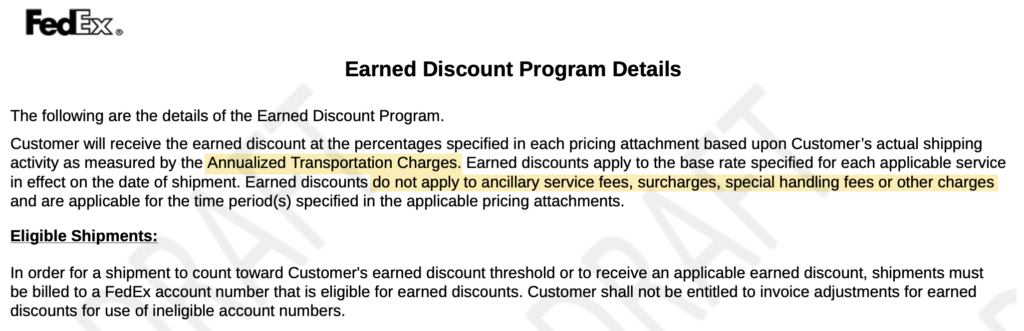
- Transportation charges are calculated on gross revenue before discounts are applied
- After any rate scale or FAK adjustments
- Exclude fuel charges and service fees
- Exclude special handling fees, duties, taxes, and other charges
To put that into perspective, let’s say your business pays FedEx $1.5M per year. You might assume that you sit comfortably in a $1.44M earned discount tier.
But a meaningful portion of that spend is almost certainly coming from fuel surcharges, additional handling, residential surcharges, delivery area surcharges, and other fees that don’t count toward the calculation.
Depending on your shipping profile, you could easily be in the $1.05M tier instead. Or potentially below it.
So before you negotiate your earned discount schedule, you need to know exactly what FedEx says your annualized transportation charges actually are. Otherwise, you’ll be negotiating around the wrong number.
How Earned Discounts Are Calculated
Earned discount tiers aren’t set at the start of your contract and locked in. Instead, it’s an ongoing calculation based on a rolling window of your current spend.
The Program Details attachment in a typical FedEx contract lays this out. Here’s an example:
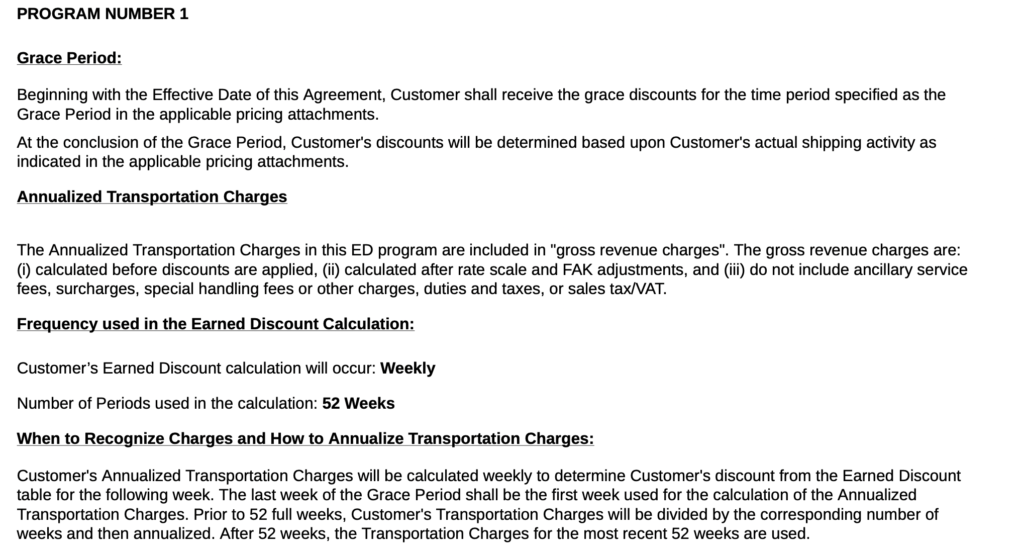
There are several things here worth explaining in greater detail.
Weekly Calculation: Earned discount gets recalculated every week. Whichever tier you’re in as of last week’s calculation determines the discount rate for the following week.
52-Week Rolling Window: The calculation uses your transportation charges from the most recent 52 weeks. As new weeks are added, older weeks drop off. This means that slow quarters or seasonal dips can push you into lower tiers if higher weeks fall out of the window.
Ramp-Up Period: During the first 52 weeks of a contract, FedEx doesn’t have a full year of data yet. In this case, the shipper’s transportation charges are divided by the number of weeks and then annualized. So your tier is based on a projection instead of actual dollars spent so far.
Grace Period for New Contracts: New contracts commonly include a grace period, in which the shipper gets a flat “grace discount” while the calculation window fills in. Once the grace period ends, actual shipping activity determines the tier. This means that if your projected volume was ambitious and your actual volume fell short, shipping could sharply increase after the grace period as your discount drops.
There is No Standard FedEx Earned Discount Schedule
It’s also worth noting that whatever FedEx offers you is completely customized based on your volume, shipping profile, and how well you can negotiate.Different shippers can get totally different structures.
Here’s a another earned discount pricing schedule from a smaller shipper with a different profile:
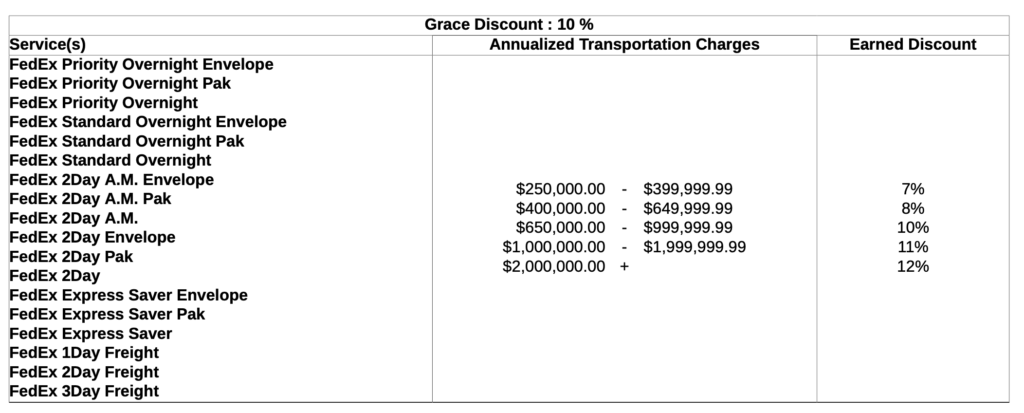
Compare that to the first example we looked at earlier.
In this case, the smaller shipper starts earning a discount at just $250k in annualized charges, but tops out at 12%. Whereas the first example doesn’t earn anything until they hit $630k, but they can eventually reach 18%.
Neither structure is automatically better.
What matters is where the shipper actually sits. A company with $800k in qualifying volume would care a lot more about earning 10% at a reachable threshold vvs. A hypothetical 18% discount at $3.36M they’d never see.
So you can’t benchmark your earned discount against “what other shippers get” because there’s no such thing as a standard schedule. It’s about negotiating the tiers in your contract around your actual shipping profile.
Not All Shipments Count Toward Your Discount
It’s also common for your FedEx contract to exclude specific zones from your earned discount eligibility. Here’s an example:
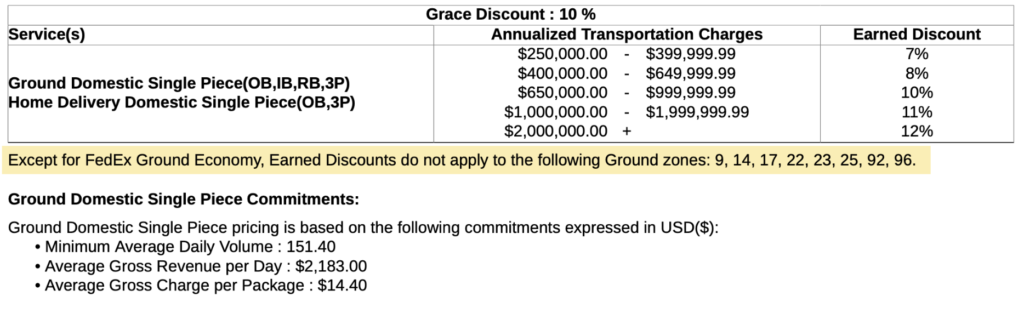
Those exclusions will typically apply to locations in the non-continental US. Like Alaska, Hawaii, Puerto Rico, and other offshore or remote destinations.
For most shippers this may be a minor detail. But if your business ships heavily to these types of locations, it’s worth checking the exclusion list with more scrutiny against your data to see what percentage of your volume falls into excluded zones.
Which Services Are Included?
Again, it depends on your specific contract. But in most cases, FedEx earned discounts cover the meat of what most shippers actually use:
- Ground Domestic Single Piece
- Home Delivery
- Overnight, 2-day, and freight services (in Express contracts)
But not everything is included. And multi-service shippers should verify which services their discount applies to. As Express-only earned discounts don’t necessarily cover ground shipments. And Ground-only may not cover Express.
If your contract has separate pricing attachments for Express, Ground, and Freight, each may have its own earned discount program with its own tier structures.
Though most modern FedEx Contracts aggregate transportation charges across FedEx Express, FedEx Ground, and FedEx LTL Freight for the purposes of calculating the tier.
Look for something like this in your contract to spell that out:
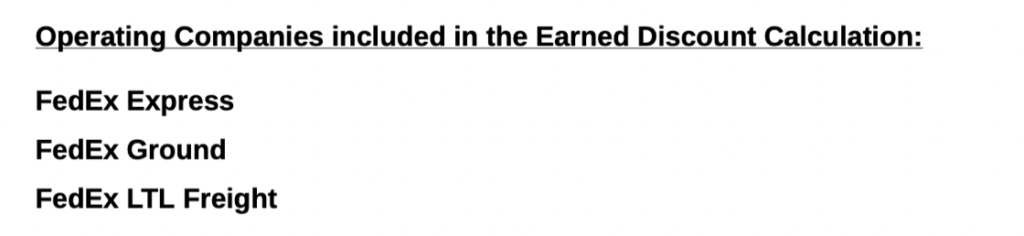
It means a shipper who uses all three carriers gets credit for combined volume toward a single discount threshold. Whereas shippers with only one service type don’t get the same benefit.
Aggregation Across Account Numbers
Businesses with multiple locations will typically end up with a different FedEx account number for each location.
Whether those accounts are aggregated for earned discount purposes is a contract-level decision that you may not think to ask about.
Say you have three warehouses that each ship $600k annually ($1.8M combined). They’d be in a top tier if aggregated. But if each account is calculated independently, each one earns discounts at whatever tier is $600k (which would be 0% for many account structures).
So if your business runs on multiple accounts, you need to confirm that all accounts are aggregated:

This could potentially be omitted if you don’t ask or verify the contract-level details.
The Difference Between Tiers Isn’t Linear
Another thing worth flagging about how the tier structures work is that the jumps between each tier are not evenly spaced. And the biggest jumps happen in the middle of the table.
Referring back to numbers in an early example:
- 10% at $630k
- 11% at $1.05M
- 15% at $1.44M
- 16% at $2.25M
- 18% at 3.36M
The gap between 11% and 15% is the biggest single jump. It’s four percentage points and happens between $1.05M and $1.44M. For a business sitting anywhere near that threshold, hitting the higher tier is incredibly valuable.
This is the type of angle that we’ve covered in our broader FedEx contract negotiation guide. It’s pushing FedEx to move the 15% threshold down to $1.05M so the shipper actually earns it.
Even without the negotiation aspect, it’s still worth knowing where the biggest jumps are in your earned discounts. As it can help you with high-level decisions, like consolidating volume to FedEx instead of splitting carriers. The push to a higher discount can potentially pay for itself in earned discounts alone compared to slightly better pricing you get elsewhere.
How to Negotiate a Better FedEx Earned Discount
Whether you’re negotiating a brand new FedEx contract or renegotiating an expiring one, here’s what you should focus on when it comes to the earned discount portion of the conversation.
Try to Move the Threshold Instead of the Percentage: Rather than harping on the percentages at each tier, the biggest opportunity is often asking FedEx to lower the thresholds instead of raising the discounts. Ask for this wherever the single biggest percentage-based jump is.
Push For Higher Discounts at Your Most Realistic Tier: Once you know how much you’ll actually spend in qualifying spend, that’s the percentage you should focus the most on. Getting extra points on volume you’ll never reach is useless.
Confirm the Grace Period: For new contracts, make sure your grace discount isn’t lower than what your projected volume would earn. Some contracts default to lower grace discounts that cost you money in the first couple of months.
Check Which Accounts and Services Are Aggregated: Multi-location and multi-service shippers need to confirm in writing that all applicable accounts and FedEx operating companies (Express, Ground, Freight) are included in the calculation.
Model Everything Against Qualifying Spend (Not Your Total): Remember, earned discounts only apply to transportation charges. Surcharges and other fees aren’t included. So you have to have the right data here that omits exclusions.
Don’t Trade Something Valuable for an Unreachable Tier: As you’re negotiating other parts of your contract, it’s common for FedEx to offer a higher earned discount for a concession somewhere else. But if that higher earned discount is in the top tier that you’ll never reach, it’s not worth a smaller base discount, shorter surcharge term, or weaker DIM factor.
Earned discounts can be one of the largest single levers in a FedEx contract. But they’re also one of the least understood.
Tiered percentages get the attention. But the mechanics behind weekly recalculations, 52-week rolling windows, zone exclusions, and other fine print are often overlooked.
Bottom line is that the best earned discount schedule isn’t the one with the most impressive number at the highest tier. It’s one built around the volume you already ship.
If you’re not sure how your current earned discount is actually performing or if you’re evaluating a new FedEx proposal and want to know whether the tier structure works for your volume profile, it’s worth bringing in some help. Our team can pull everything apart and negotiate directly with FedEx on your behalf.