

Businesses with multiple locations typically need the same supplies at every site, and it’s common for the same suppliers to service each location.
Most people assume that all of their locations pay the same prices for supplies. Whether it be food, medical supplies, cleaning products, or anything else: why would the same vendor charge you two different prices for the exact same thing? Those deliveries might even be coming off the same truck just hours apart.
Unfortunately, that assumption is often very wrong, and nobody actually checks this.
Each location’s invoices get reviewed separately by the on-site manager. And if they get reviewed at all, it’s usually just to confirm that they got billed for what they actually ordered.
But pricing differences hide in the per-item breakdowns.
Not the fees. And not the inventory list. So they never stand out, and it’s impossible to tell if you’re being billed different amounts unless you’re comparing invoices from different locations side-by-side.
Read on to find out if this is happening to you, how much it costs, and what you can do about it.
Same Vendor, Same Supplies, Different Prices
Let’s look at an example of a multi-location dermatologist practice in Florida that orders medical supplies from Henry Schein, an international supplier.
All of the locations are within about ~200 miles of each other. Though some are even in the same city.
Here’s a snippet of their order report showing four different locations that ordered the same 25-pack of 20 mL Sodium Chloride 0.9%.

Looking at the report, we can see it’s the exact same 7-digit item code from Henry Schein. Yet if we look at the last paid price column for each location (highlighted), the numbers are different:
- Location 1 – $30.07
- Location 2 – $27.33
- Location 3 – $47.99
- Location 4 – $27.33
The highest price is about 76% more than the cheapest price.
And this isn’t a one-off. Here’s another example from the same report:
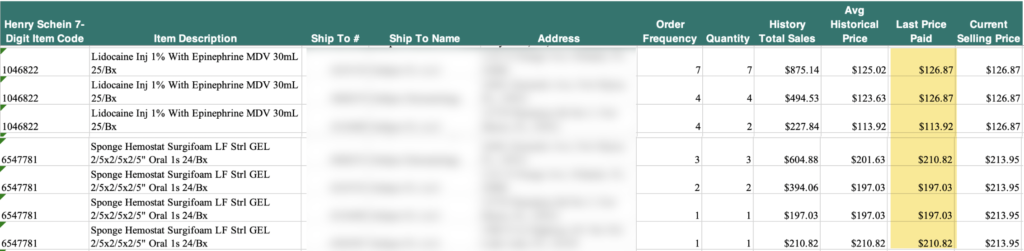
A 25-count box of 30 mL Lidocaine Injections cost $113.92 at one location and $126.87 at two others. Additionally, two locations paid $197.03 for Surgifoam sponges while another two paid $210.82 for the exact same sponges.
In total, we found 20 unique items that had different prices across locations in this month alone.
But to find it, we had to look through nearly 300 line items. And that’s just something the average dermatologist office doesn’t have time to do every month. Nor do they have someone responsible for something like this.
How Each Location’s Prices Drift Apart
The biggest issue is that each location is usually treated as its own account on the supplier’s side. Even if it’s the same business, same owner, and payments are all coming from the same place.
In the Henry Schein example above, each location is identified as its own account number in the ship-to column (which I redacted to keep the client’s information private). But it shows how vendors usually handle different locations internally.
Other common reasons why pricing is different across locations:
- Accounts were set up at different times
- Different people at the business set up the account (Example: location manager)
- The vendor sales rep is different for each location
Think about how this happens in a practical sense.
A restaurant may not open their second location until five years after the first one. So when the chef at the new location orders food from the same vendor as the first one, a new account is typically set up and that may be handled by a completely different rep.
Hotels can run into the same issue when they buy out a competitor across town and begin ordering the same bathroom supplies or linens as their first location.
Consistent pricing isn’t guaranteed unless someone on your end takes the time to not only request it, but then verify it once supplies start getting delivered and billed.
The Pricing Gap Repeats on Every Order
Different prices on a single item looks too small to matter. So in isolation, it’s easy to overlook and dismiss.
But when it repeats on every reorder, every single month, you’re talking about thousands of dollars in overpayments that could easily be avoided.
Especially for items at scale.
Look back to the example earlier of a single item from a medical supplier costing $20 more at one location compared to another. At 30 boxes per month per location, that’s a $600 price difference. And $7,200 in overbilling per year.
And that’s just for one item at a second location.
You might have three additional locations paying the higher price. Now we’re talking about nearly $30,000 in overspend, still for that same item.
The more locations you have, the more that gap multiplies.
And it also means that you’re not being priced on your combined spend. So it’s not just about getting every location to the cheapest rate that you’re currently paying.
The gap is actually much larger when you consider that your pricing everywhere could be lower if your supplier factors in your total volume everywhere.
Comparing Prices Across Your Locations
There are a couple of ways to do this and it honestly depends on how many locations you have and which suppliers you’re comparing.
In some cases, you may need to look at each location’s orders side-by-side. But ideally, you want a complete purchase history broken out by location in a single report.
Then you can line up the same line item numbers across locations to quickly compare any discrepancies.
But you should also be looking out for different pack sizes that make prices look different when they actually aren’t. Or this can make prices look the same when you’re actually getting less.
For example, say two locations both pay $15 for a box of nitrile gloves. It looks like the same price, but one location is getting a 100-count box while the other is getting a 50-count box. Meaning that second location pays twice as much per glove without anyone noticing.
Which is why you need to compare the price per unit and not just the price per box.
It’s also worth noting that any item not part of your contracted rate will automatically get charged at the supplier’s regular price. This can change at any time. So it’s important to make sure each location has the same items contracted and that you’re not unknowingly ordering items outside of the discount.
Getting Every Account on the Same Price
You don’t need to switch suppliers or vendors to get consistent pricing. But it starts with understanding what you’re paying everywhere.
From there, you can have a conversation with your current suppliers using actual item codes and prices from your own order history. And not just calling to say, “I want to make sure I’m paying the same rate at all of my locations.”
The latter won’t get you very far.
Next:
- Ask for one pricing agreement that covers every location.
- Make sure the contract pricing is applied to every account.
- Request volume discounts based on your total spend, not for each individual location.
Your suppliers know that you can likely get the exact same items elsewhere. So they should be fairly willing to work with you on this.
But you can’t take their word for it if they agree to do better. You need to continue checking your prices every single month because those prices can continue to drift again over time. And the same issues can arise again if you expand, open a new location, add a supplier, or a different person starts ordering things.
The initial pricing audit and ongoing monitoring takes real time and effort. But as you can see from the simple examples discussed, it could easily result in tens of thousands of dollars in savings.
If you don’t have someone who can do this for you internally, The Cost Guards can handle it all on your behalf. Book a free consultation today to find out how much you can save on supplies for your business, without changing vendors.
We’ll negotiate better rates with the suppliers you’re already using.