
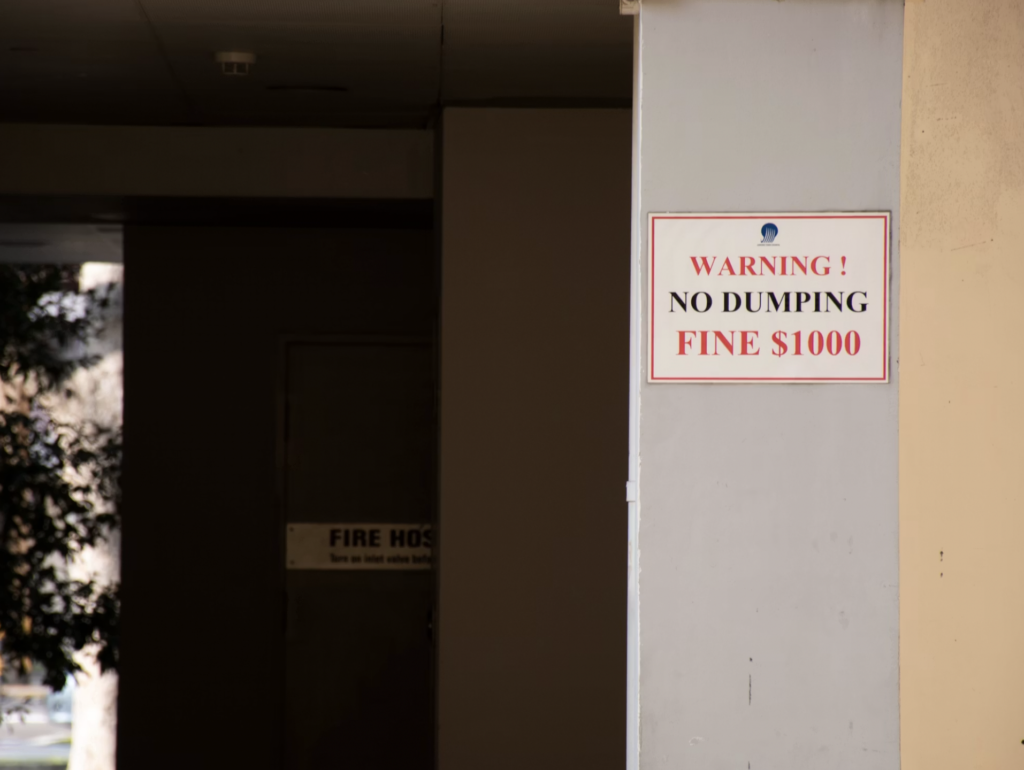

Waste management fines are honestly fairly easy to overlook when assessing your business expenses.
And in most cases, businesses aren’t intentionally breaking waste laws. Violations can happen because an employee puts something in the wrong container, a dumpster overflows, or nobody realized that a local law has changed.
But the costs can compound, as they can come from both local regulators and your hauler. So you shouldn’t dismiss them.
While the exact details vary by location or violation type, most of these fines and penalties come from a predictable group of mistakes that can be avoided.
Waste Management Rules Are Mostly Local
First and foremost, it’s worth understanding that there is no single nationwide set of commercial trash and recycling rules for every business to follow. The rules vary based on:
- State, city, or county
- Business type
- Property type
- Waste volume
- Materials being discarded
- Local waste hauling market
Federal regulations establish minimum requirements for landfills, hazardous waste, and rules for certain other regulated materials. But states play the primary role when it comes to regulating nonhazardous solid waste, and local cities can impose their own rules for collection, recycling, organics, containers, and enforcement.
That’s why just copying and pasting waste procedures from one business to another location doesn’t always work, even for operations with multiple locations in the same state.
A process that’s fully compliant at one property could result in fines somewhere else. Operators assume that the same signage or sorting procedures and pickup practices can be used everywhere.
But every single property needs to be evaluated for compliance against its own local requirements.
7 Common Reasons Why Businesses Get Hit With Waste Management Fines
Nearly all commercial waste violations fall into one of these seven categories:
1). Overflowing or Improper Containers
An overflowing dumpster is one of the most visible signs that a business does not have the waste service it needs.
- Trash extending above the container
- Lids that won’t close
- Loose bags placed next to the dumpster
- Leaking or damaged containers
- Waste stored outside the designated area
- Dumpsters blocking sidewalks or access points
And while many of these can lead to surcharges from your hauler, it’s also common for cities to impose penalties for certain law violations.
For example, New York City requires businesses to use bins with secure lids for trash, food waste and food-soiled paper. They also require businesses to have enough containers to hold waste generated during 72-hour periods. In certain areas, bins can’t be placed at the curb before 8:00 PM, and empty bins must be removed by the time the business opens.
These exact hours and rules don’t apply everywhere, but they demonstrate how something as simple as taking out the trash can create a violation.
2). Recycling Contamination
Recycling contamination occurs when trash or other prohibited items get placed into a recycling container.
Things like food, liquid, plastic bags, batteries, electronics, greasy packaging, and styrofoam are all examples that can create contamination penalties. Even certain types of plastic that aren’t recyclable can result in fines.
The problem here is that it typically creates two different costs.
First, contamination can result in violations of local recycling ordinances. For example, commercial recycling penalties in Washington DC range from $200 to $1,500. Second, your waste hauler may add contamination fees to your invoice, which isn’t part of the charge coming from the government.
You need to ensure your recycling process is simple for everyone involved. Whether that’s for employees, tenants, customers, or cleaning crews. Basically anyone who has access to your recycling containers on site. Everything needs to be clearly labeled, conveniently located, and consistent throughout the property.
3). Incorrect Dumpster Placement or Storage
You typically can’t just place a dumpster wherever is most convenient for your business. Depending on the property location, there could be local rules that govern:
- Distance from property line
- Sidewalk and road clearance
- Fire lane access
- Dumpster enclosures
- Screening or fencing requirements
- Storage between collections
- Placement in a public right-of-way
- Accessibility for collection vehicles
Don’t just assume your hauler is going to handle this stuff on your behalf. If they aren’t the ones getting hit with fines, they have no incentive to ensure you’re compliant.
4). Missing Permits, Decals, or Waste Plans
Even if the waste itself is handled correctly, businesses can still be fined because they don’t have the required documentation.
Certain jurisdictions require businesses to maintain or display items like dumpster permits, private hauler decals, collection schedules, and employee education materials.
In Boston, businesses using bulk refuse containers need to obtain a Site Cleanliness license. The license is just $50. But non-compliance penalties can reach up to $1,000 per day after multiple offenses.
5). Throwing Prohibited Materials in Standard Trash
Not every piece of waste generated by a business can go into its regular dumpster. Depending on your location, you may need separate handling for things like:
- Fluorescent lamps
- Pesticides
- Used oil
- Paints and solvents
- Chemicals
- Batteries
- Aerosol cans
- Medical waste
- Automotive fluids
- Equipment containing mercury
Federally universal waste regulations cover five categories: batteries, certain pesticides, mercury-containing equipment, lamps, and aerosol cans. But states can modify their programs or regulate additional materials (and the state requirements are usually stricter than federal standards).
Hazardous waste requirements can be even more extensive. If this applies to you, you may need to identify the waste, use appropriate containers and labels, maintain records, and follow specific transportation and disposal procedures.
6). Failing to Separate Organic Waste
Organics requirements have expanded in several parts of the country. But the businesses covered under these rules and the thresholds used can vary significantly.
These local regulations may apply to:
- Food scraps
- Food-soiled paper
- Yard waste
- Non-edible food
- Certain compostable products
Here are some examples that show how widely different local organic waste regulations can be:
California: SB 1383 requires jurisdictions to provide organic waste collection to residents and businesses unless an exemption waiver applies.
Massachusetts: Anyone generating at least one-half ton of food material per week are prohibited from disposing of that material in regular trash.
Connecticut: Commercial organics law uses an annual generation threshold, applying to locations generating at least 26 tons or more of source-separated organic material per year (even if that waste is generated seasonally).
That’s why you can’t just rely on a generic list of food waste bans or apply the same policies to every location. Organics compliance is particularly important for restaurants, hotels, grocery stores, food manufacturers, and other businesses generating a significant amount of food waste.
7). Using the Wrong Hauler
Some states, counties, and cities regulate who is allowed to haul waste in the area. In open markets, you’re typically allowed to use any company you’d like. But in franchise markets, your options may be limited.
Businesses may be required to:
- Use a licensed or registered company
- Select from a list of authorized haulers
- Maintain a written agreement
- Use different providers for different waste streams
- Keep collection records
- Register as a self-hauler
- Display the hauler’s information
This means that just selecting the cheapest company without first checking local requirements can create compliance problems.
Government Fines and Hauler Penalties Are Not the Same
You need to understand exactly where the penalty is coming from, as government fines and hauler penalties are not interchangeable (though they can stack on top of each other).
Government fines are issued because your business has allegedly violated a law, ordinance, permit requirement or sanitation rule.
Hauler penalties are extra charges added to your waste service agreement.
Some examples of hauler-added penalties may include:
- Overage fees
- Contamination fees
- Extra pickup fees
- Blocked access fees
- Dry run fees
- Equipment damage fees
- Service interruption fees
These charges may be legitimate, but they shouldn’t automatically be treated as valid. And they aren’t necessarily due to any “regulations” being violated (despite how they show up on your invoice).
The biggest difference here is that hauler penalties can typically be negotiated. This is between you and your hauler, and has nothing to do with local laws.
How to Prevent Waste Management Fines and Penalties
Compliance works best when it’s part of your normal operation. Not just something you reviewed after you receive a citation.
One-off fines can happen to anyone. But if you’re continuing to get hit with excess fees, I recommend the following.
Create Requirements for Each Location: Take the time to understand the local rules and regulations that apply to every location you operate. Document things like sorting rules, container requirements, hauler restrictions, etc., and don’t assume that locations in different cities within the same state follow the same rules.
Use Clear and Consistent Signage: Label every container based on the actual materials accepted by your local program and hauler. Generic recycling symbols are not always enough, and that’s often where we see people run into issues as employees may not realize that things like plastic bags or food-soiled paper can’t be mixed with other recyclables.
Match Service Levels to Actual Waste Volume: If your containers are consistently overflowing, it’s a sign that you either need more pickups or more capability. That said, don’t just blindly accept a hauler’s recommendation to increase your service. Audit this yourself to see what your needs actually are.
Train Everyone Who Handles Waste: In addition to your management team, the people who actually handle your waste need to understand proper procedures. This includes everyone from staff to contractors, kitchen workers, tenants, cleaning crews, maintenance teams, and beyond.
Keep Compliance Records Accessible: Maintain organized copies of your permits along with hauling agreements, invoices, inspection notices, and service records. These documents can help you quickly resolve a citation that shows your business is compliant.
Audit Every Waste Invoice: Don’t just look at the total amount due. Compare each fee against your contract and request evidence for incident-based charges. Remember, extra fees imposed by your hauler shouldn’t be confused with fines or penalties assessed by local governments.
What to Do After Receiving a Waste Fine
Don’t automatically pay a citation or hauler penalty without understanding what happened. Taking the time to figure this out can ensure you aren’t being unfairly charged while also preventing the issue from happening again.
The first thing you should do is determine who issued it. Was it from a government agency, property manager, waste broker, or hauling company?
From there:
- Request the specific rule or contract provision that was violated (if not clear from the citation).
- Confirm the date, time, container, and correct property.
- Review any photographs, inspection notes, or driver records.
- Determine whether there is a warning or appeal period.
- Correct the operational problem immediately.
- Dispute any factual errors or unsupported charges in writing
- Track whether the same issue appears again.
You also need to recognize that a government citation and hauler invoice charge may require completely different dispute processes. So treating them as the same (even for the same incident) can cause you to miss appeal deadlines or mis-manage how you challenge the penalty.
Final Thoughts
Waste management fines typically don’t result from a single major failure or gross negligence.
They accumulate over time through small operational problems that get overlooked. Small costs may start appearing on your invoice from the hauler or a warning gets issued in the mail. Before you know it, the city starts fining you $1,500 per day per dumpster for repeat violations.
While local compliance rules determine how your waste needs to be handled, it doesn’t give your hauler permission to add unsupported fees or charge more than your contract allows. And unfortunately, these types of predatory billing practices are far too common in the industry.