


Weekly shipping invoices from UPS are hard to keep track of. They can be ten pages long, detailing every package you shipped during the period.
Most businesses just glance at it, pay, and move on.
But buried inside is a category called Adjustments & Other Charges that shows up as a single dollar amount on the summary page (easy to overlook and dismiss). If you dig deeper, you’ll find that these are retroactive charges on packages you already shipped.
These are shipping charge corrections. And for businesses doing a high volume with UPS, they’re likely costing you a lot more than you realize.
What Are UPS Shipping Charge Corrections?
When you ship a package with UPS, you’re billed based on the information that you provide at the time of the shipment (weight, dimensions, service type, etc.). That charge is what shows up on your weekly invoice.
But UPS doesn’t take your word for it.
UPS audits shipments by weighing packages, measuring dimensions, and evaluating whether the correct surcharges were applied. If they find a discrepancy between what you reported, they go back and add the difference.
They aren’t necessarily penalties or disputes in the traditional sense. UPS is contractually allowed to audit shipments and adjust accordingly. So this is what you should have paid for those packages originally.
Where to Find Them on Your Invoice
The total shipping charge correction is included in the “adjustments” line item of the summary on page one:
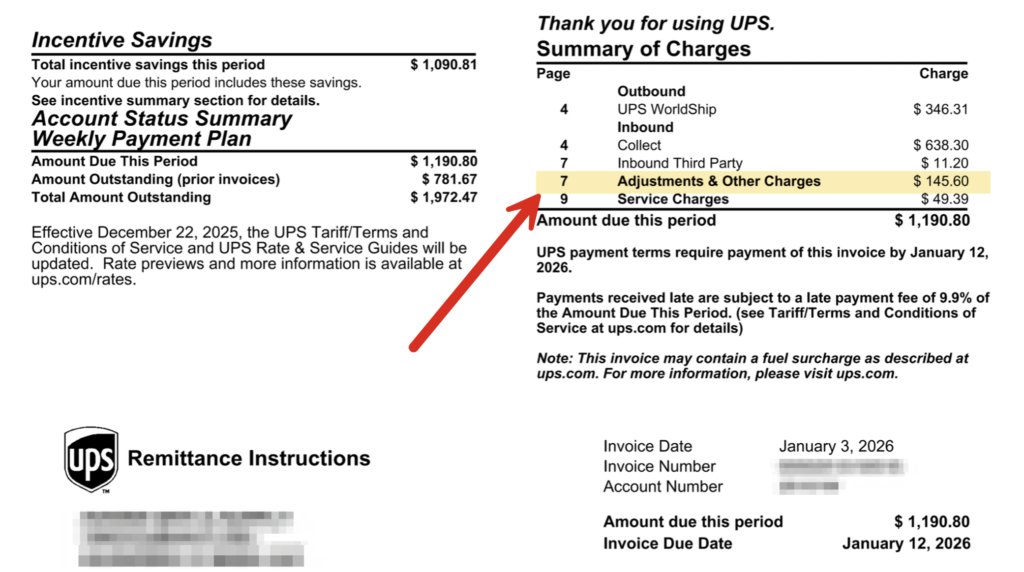
For most shippers, that’s as far as they get. Spending more than a few seconds glancing at the summary every week is all the time that many businesses have for this.
They look at the total, see that it roughly aligns with previous weeks, and that’s it.
But the actual details of these charges live within a subsection of the adjustments called Shipping Charge Corrections.
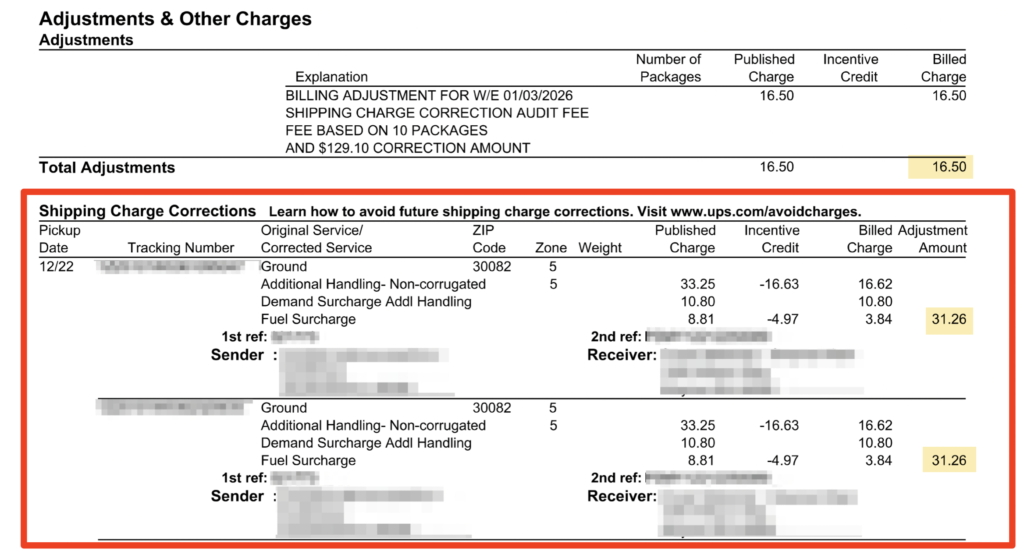
Each corrected package is listed individually with the pickup date, original service, corrected service, tracking number, recipient, reason for correction, and adjustment amount.
As you can see from the example above, both of these packages required additional handling, had a demand surcharge applied on top of that additional handling, and a fuel surcharge.
If you look to the far right column, each of these corrections cost this shipper an extra $31.26. That’s on top of whatever was charged originally for these packages on the previous invoice.
You can also see that UPS is charging this business $16.50 for the audit. That’s $16.50 for the privilege to charge you extra.
What Triggers a Shipping Charge Correction
UPS corrections get triggered a few different ways, and they don’t all look the same on your invoice. Examples include:
Wrong Dimensions
This is probably the most common reason we see. Whenever you ship a package, the box dimensions get entered into your shipping system. If UPS measures that package at their facility or in transit and gets a different number, they’ll rebill based on their measurement.
The difference doesn’t have to be significant. We’ve even seen corrections triggered by a single inch:
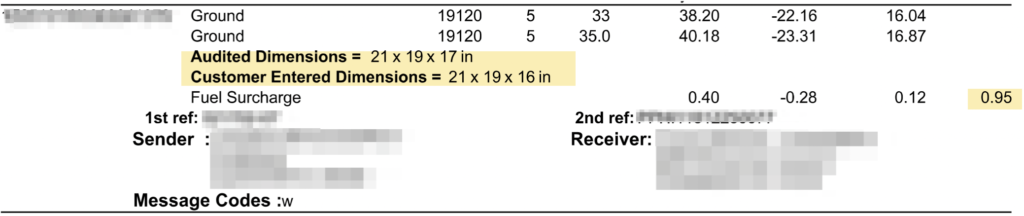
On this statement, the shipper entered 21x19x16, but UPS measured it at 21x19x17.
That one inch bumped the billable weight from 33 pounds to 35 pounds, and ultimately resulted in a $0.95 correction.
Less than $1 obviously isn’t anything to lose sleep over. But it shows that UPS isn’t going to let anything slip. And at scale, this is obviously going to be a problem. If there’s a larger discrepancy on a high volume of packages, you’re going to pay a lot more.
That happens to some businesses if an employee mis-measures a box once, and then applies those same dimensions to hundreds or thousands of those same-sized boxes until the error is found.
Weight Discrepancies
Similar to a dimension discrepancy but based on the actual weight of the package based on the size.
If UPS weighs a package on their own scale and gets a different number than what was entered, they rebill at the higher rate. The correction charge is the rate difference plus any fuel surcharge adjustment on top of it.
Surcharge Misclassifications
If a surcharge wasn’t properly applied on the original shipment, these can be more expensive because the surcharges compound on the higher rate.
For example, let’s say that UPS determines one of your packages should have triggered an additional handling surcharge. This can apply to:
- Non-corrugated packaging
- Poly bags
- Packages that exceed certain size thresholds
They’ll go back and add it retroactively. But what makes this so costly is that the additional handling doesn’t come alone.
When it applies, it can automatically pull in a Demand Surcharge for Additional Handling on top of it. And since both of those charges increase the billable amount, a fuel surcharge gets recalculated upward as well. Here’s an example:

A single misclassification here turned into three separate line items added to a future invoice. In this example, it resulted in an additional $31.26 after all three charges were stacked (and this happened to several shipments in the same billing period).
UPS Shipping Adjustment Codes
You may also find certain one or two-character codes attached to certain adjustments. Here’s what they mean:
- bf — Custom dimensional weight applied
- ag — minimum rates applied
- a1 — additional handling minimum billable weight applied
- KD — charges based on customer-provided information
- w — dimensional weight adjustment based on UPS audit
- v — weight adjustment based on UPS audit
Why This Makes Your Shipping Costs Harder to Track
What makes shipping charge corrections different from a normal billing dispute or penalty is that they’re applied to packages that were shipped and then buried in a separate section of the invoice.
The packages were delivered, and the transaction felt like it was complete. Your team already moved onto next week’s shipments. Then an invoice arrives with corrections buried in the adjustments section.
While it’s natural to just move on, it’s one of the main reasons why the core problem never gets fixed. By the time an error is caught, it’s too late to do anything about it.
And beyond the direct cost, there’s also a tracking problem that doesn’t get talked about enough.
If the correction is applied retroactively, the cost for a single week’s packages can’t be fully measured until weeks later (if at all). So if you’re trying to accurately track your costs per shipment, you need to account for adjustments. That includes reconciling for any corrections.
How Much This is Actually Costing You
In a single invoice from one of our clients, the Adjustments & Other Charges line came to $145.60. I highlighted that number in the first screenshot of this post.
That breaks down to $129.10 in shipping charge corrections across 10 packages and a $16.50 audit fee.
And that’s just a single week for a relatively low-volume shipper.
For a business doing that same volume every week, corrections can add up to somewhere in the range of $7,500 per year in charges that were never on the original bill.
Businesses most exposed to these overages are the ones shipping the same product in the same packaging every single week. As a single measurement error or packaging misclassification is multiplied across every shipment until someone catches and fixes it.
Can UPS Shipping Adjustments Ever Work in Your Favor?
Actually, yes. If UPS audits a package and determines that the mistake leads to you being overcharged, they’ll credit you for the difference.
But there’s a catch (or two).
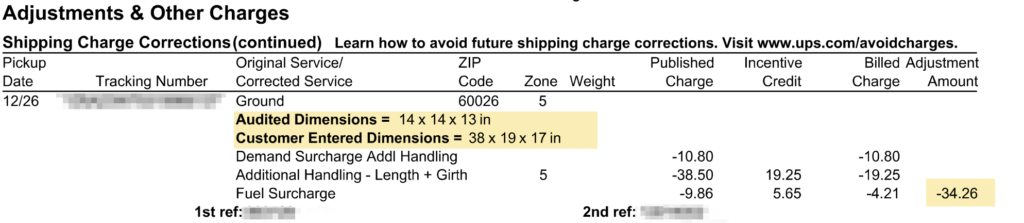
Here’s an example where the customer’s dimensions entered were drastically higher than the actual dimensions found in the audit. As a result, they received a $34.26 credit in their favor.
So what’s the catch?
First, UPS charged $16.50 to audit these packages. So that right there effectively cuts the credit amount in half.
Second, there will always be a disproportionately low amount of corrections in your favor compared to the ones that cost you more money. We audit thousands of these invoices for clients, and that’s just always the way it is.
I find it slightly suspicious that if the shipper constantly makes errors, the errors always result in underpayments that mean they owe more money to UPS later on. You’d think there would be an equal probability of a mistake being made in the other direction (as shown above).
But I’d say that only happens 5% to 10% of the time at an absolute max.
UPS doesn’t have much of an incentive to audit packages that result in them sending money back to you.
Final Thoughts
Technically, shipping charge corrections and adjustments from UPS aren’t penalties. They’re just making themselves whole on what the original package should have been charged for.
The problem is that most shippers never look at these charges closely enough to understand what’s driving them.
A single measurement or packaging misclassification gets repeated across hundreds of shipments until someone catches it. And it can’t be caught if you aren’t looking for it.
The solution starts with reviewing every part of your UPS invoice, including the adjustments section. If you’re seeing the same types of problems every week, it needs to be addressed.
This is just one of the many things we look for when auditing shipping statements here at The Cost Guards. Reach out for a free invoice review, and we’ll tell you what’s in there and how much you can save.