

Most businesses shipping with FedEx don’t realize how much of the agreement is actually negotiable. And the ones that do negotiate often focus on the wrong numbers.
Here’s a closer look at what’s actually on the table with FedEx shipping contracts.
This is based on our experience negotiating with FedEx on behalf of our clients. And I’ll even walk you through a recent proposal FedEx sent us, including where we countered after seeing their first offer.
Base Rate Discounts Are Just the Starting Point
When FedEx sends over a custom pricing proposal, the first page or two will typically show base discounts off published Ground and Home Delivery rates. Something like this:
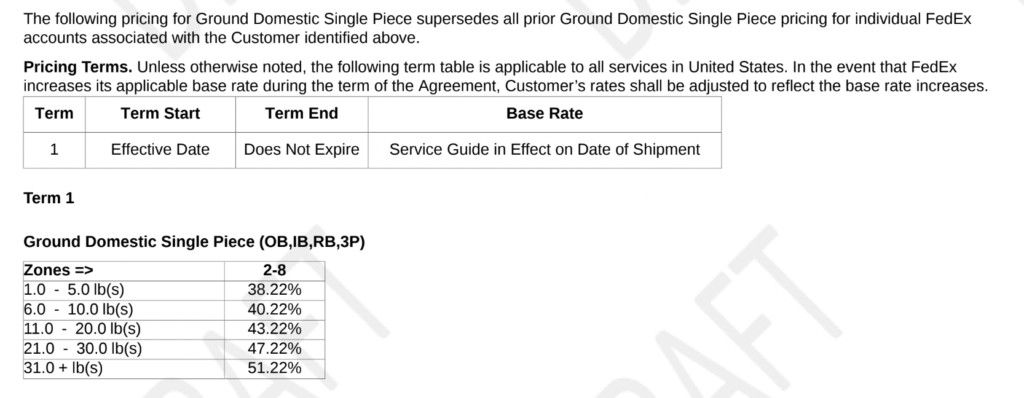
They lead with this discount because that’s the number you’ll remember.
In this case, they’re offering discounts ranging 38% to 51% depending on the zone. It looks like meaningful savings (which it is). But it’s also the easiest concession for FedEx because they know they can make up their margin in the rest of the contract.
So while it’s definitely a solid starting point, you can’t end the negotiation here because the vast majority of your shipments will likely incur additional fees.
Earned Discount Tiers
Almost every custom FedEx shipping contract will include an “earned discount” program. This is an additional percentage discount that kicks in when your annual charges hit certain thresholds.
It’s a tiered system that stacks on top of your base discounts. Here’s an example that was offered to one of our clients:
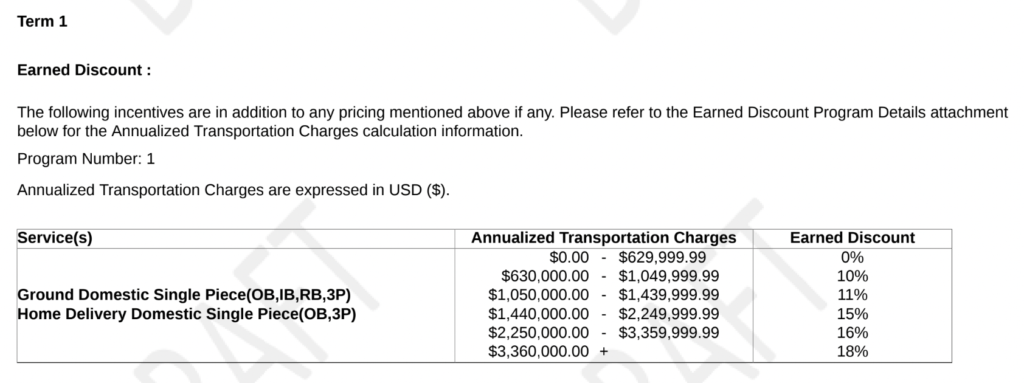
Two things matter when negotiating these tiered discounts, but most shippers only think about one.
The first is obvious: the percentages themselves. Pushing 11% to 12% or 13% at each tier. That’s worth fighting for. But the gains don’t amount to anything if you don’t hit the thresholds.
The biggest lever to pull is focusing on which tier you actually sit in.
If your annual spend on shipping is $1.4 million and the contract gives you an earned discount at 11% all year, you’re looking up at extra discounts you can’t quite reach. Instead, push FedEx to move that 15% discount threshold down by one tier, so it kicks in at $1.05M instead of $1.44M.
This simple yet highly overlooked negotiation point can easily save you $30k to $45k in a single year, with no growth required. You’ll get savings on the volume you already ship.
Weight Break Discounts on Heavy Packages
If you ship anything over 30 pounds, the weight break discount on packages 31+ lbs is worth fighting for.
Base discounts on heavy packages are typically the highest available on the table. And we’ve seen FedEx offer 50% discounts to high-volume shippers without batting an eye here.
Though they start to push back when you start asking for 55% or 60% discounts.
In these cases, it’s common for them to offer concessions elsewhere to compromise. If they do, just make sure those offers are actually going to benefit your business.
Say they deny a weight break discount of 55% but offer you another 4% earned discount at a tier you’ll never reach. You’ll never actually see those savings.
But the amount of time you spend on this line depends on your shipping mix. If it skews heavily, it’s definitely worth your time. But if your packages are mostly lighter, the earned discounts are more important.
Surcharge Discounts
Here’s the trend where businesses haven’t quite caught up yet. Carriers like FedEx and UPS don’t make their margin on base rates anymore.
They profit from surcharges. And those rates have been climbing faster than base rates for years.
For example, the 2026 General Rate Increase from FedEx averaged 5.9% effective on base rates. But specific surcharges went up by significantly more, with some exceeding 15% for certain packages.
Here’s where you should focus:
Additional Handling Surcharges
This one is huge. It’s crucial for businesses shipping furniture, equipment, or any large or awkward items.
We’ve seen FedEx increase this surcharge by over 50% in the last few years on some of our clients with custom contracts. And for one particular high-volume shipper, over half of their shipments are hit with this surcharge.
Fighting for extra percentages can result in massive savings if the majority of your packages require additional handling.
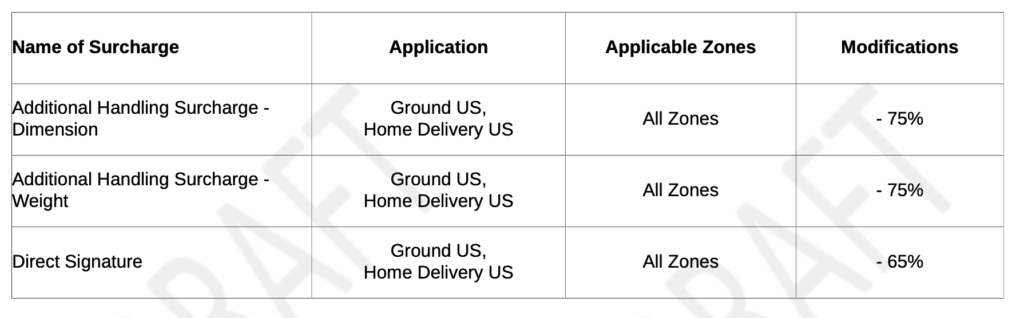
And as you can see from the proposal above, FedEx is often willing to discount these heavily. With discounts in the 75% range.
Fuel Surcharge
Fuel surcharges fluctuate throughout the year, which is why it’s so important to get a good discount built into your FedEx contract.
For example, a 20% fuel discount may sound reasonable when FedEx sets these surcharges at 15%.
But it’s not quite as good when those variable rates jump to 23% and stay there. So shoot for discounts in the 25-30% range as a discount off fuel. And make sure it includes explicit language that the discount holds even when the table resets again.
Residential Surcharge
If you ship items directly to consumers, this is one of the most important charges to focus on.
Pushing the discount from say 60% to 65% may seem small. But multiplied across every residential delivery for an entire year is significant.
This one is usually winnable, too.
Direct Signature
A 50% discount is standard here. So it’s reasonable to ask for 65%, and maybe end up meeting somewhere in the middle.
Lots of shippers don’t negotiate this one at all because the per-package cost feels small in isolation.
Address Corrections and On-Call Pickups
These often start at zero, which means you’ll pay the full published rate.
You can do better. Aiming for a 25% to 50% discount here is purely free money since these surcharges aren’t part of the headline pitch.
DIM Factor Adjustments: The Hidden Savings Multiplier
FedEx uses dimensional weight factor (DIM factor) to convert a package’s volume into billable weight.
The current DIM factor published by FedEx is 139. This means that a 12x12x12 inch box (1,728 cubic inches) gets billed as if it weighs 12.5 pounds (1,728 divided by 139), regardless of what’s actually inside of it.
During FedEx contract negotiations, the DIM factor can be raised. Higher DIM factor = lower billable weight on the same packages.
When the base rate is lower, that means fuel surcharges and other percentage-based surcharges are also lower. So it’s a big deal all around.
DIM factors can be negotiated in the 200 to 300 range.

So let’s say you negotiate a factor of 250 (as shown above). That same 12x12x12 inch box would get billed as if it’s 6.9 pounds (vs. 12.5 lbs for the standard DIM factor).
The catch is that FedEx will resist DIM factor increases harder than almost any other concession because they know how much it costs. Getting a 250 DIM factor is a strong outcome for most contracts. But I’d say 300 is achievable for the right shipper (with real volume as leverage).
Watch When Your Surcharge Discount Expires
This might be the single most overlooked element of a custom FedEx shipping contract. It’s where most businesses realize months later that their “great deal” wasn’t quite as good as they thought.
That’s because FedEx splits its surcharge discounts into terms, like this:
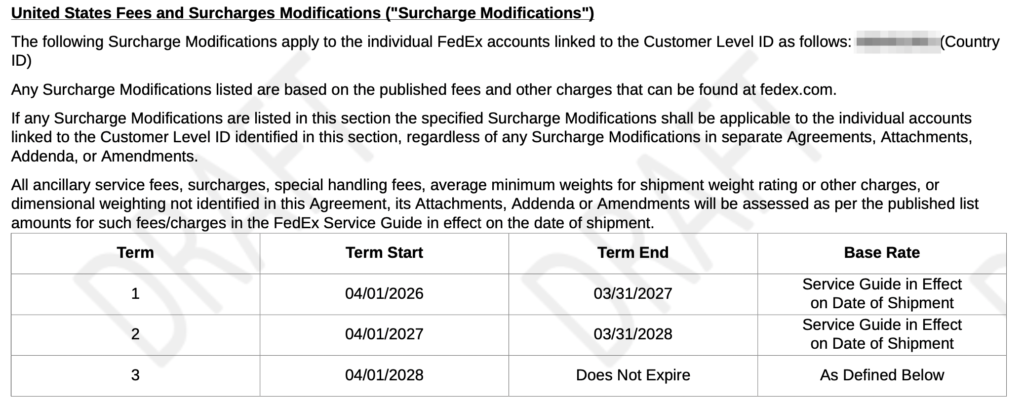
Here’s how this is typically structured.
A shipper who negotiates a 75% discount on additional handling for Term 1 might get that dropped to 67% in Term 2. And then it disappears entirely in Term 3.
So if you’re not actively re-negotiating before each term ends, it means you’re paying full price without realizing it (or at least until you come to new terms, where FedEx will likely drag their feet).
Your best option here is to push for 24 months on surcharge discounts with no changes into Term 2. And then set a calendar alarm to start negotiating again around 20 months, so you have everything set before those discounts expire.
What to Expect When Negotiating Custom Contracts With FedEx
The most important thing you need to understand about this negotiation process is that you’ll need to go through multiple revisions to get the best deal.
You send a request. They send an offer. And whether they accept or reject your terms, you should still prepare another counter-offer.
That’s where most shippers get it wrong. Let me explain why.
We recently negotiated with FedEx on behalf of a client spending about $1.5M annually on shipping. And we asked for discounts in every single category mentioned above. FedEx accepted some. Didn’t budge on others. And met us in the middle for the rest.
But since they didn’t meet all of our requests, it gives a chance to counter again even on the terms they accepted.
For example, we asked for a 15% earned discount at a lower tier threshold, which was accepted in the offer. Now we’re asking for 18% here because they didn’t meet our request for weight breaks.
The key here is finding the right balance because these negotiations aren’t instant, and FedEx often postures because it’s in their best interest to hold out. The longer it takes you to sign, the longer you’ll be paying higher rates. So it’s expensive.
You need to pick and choose where you want to fight for better terms, while still being firm in your counter-proposals. Don’t be afraid to ask for better discounts. The worst they can say is no.
What to Do Before You Sign Anything
FedEx contracts are dense, and the points where you have the most leverage are often buried deep in the contracts.
You need to understand that FedEx does this every single day, whereas you’re doing it once every few years.
To help stack the deck in your favor, it’s worth bringing in an outside consultant advocate for you at the negotiation table. Someone who knows how low FedEx is willing to go because they have proof from other contracts.
That’s exactly what we do here at the Cost Guards. Just reach out for a free consultation, and we’ll review your FedEx shipping contract to see if there’s even more room to counter.